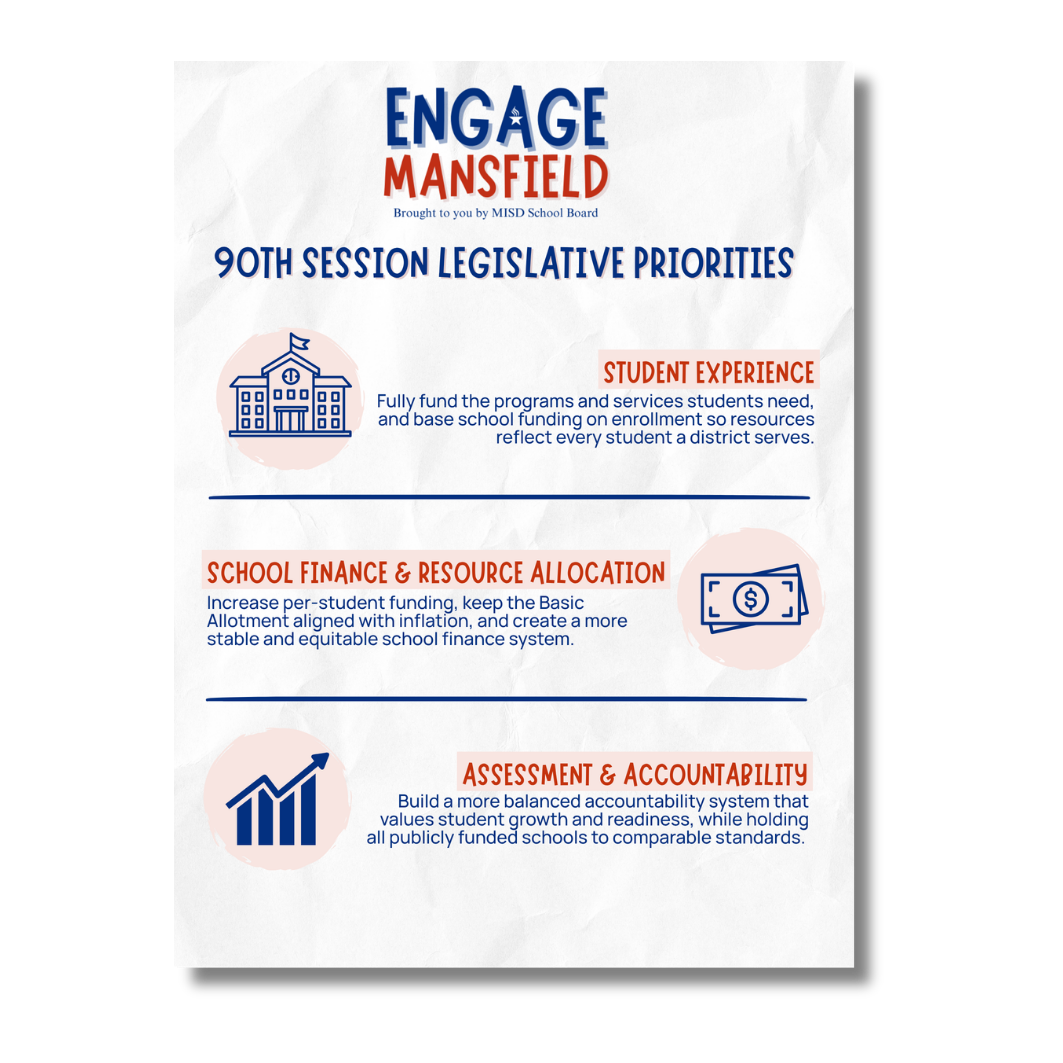
Meet Our 90th Session Priorities
The decisions made during the 90th Texas Legislative Session will directly impact Mansfield ISD students, staff, families, and classrooms. The Mansfield ISD School Board has identified three priority areas and six legislative priorities focused on creating a stronger, more sustainable future for public education.
Why the 90th Texas Legislative Session Matters
Every two years, the Texas Legislature meets to make decisions that directly impact public education. During the 90th Legislative Session, lawmakers will consider policies that shape how schools are funded, how student success is measured, and what resources districts have available to serve their communities.
For Mansfield ISD, these decisions reach far beyond the state level. They affect the programs and services available to students, the resources provided to teachers and campuses, and the district’s ability to plan responsibly for the future.
The Mansfield ISD School Board has identified six legislative priorities focused on three key areas: Student Experience, School Finance & Resource Allocation, and Assessment & Accountability. Together, these priorities reflect what the district believes is necessary to support students and strengthen public education.
Understanding these priorities helps our community see how decisions made in Austin can directly impact Mansfield ISD classrooms, campuses, students, and families.
Six priorities, built around what our students need
-

Student Experience
Fully fund state mandates and special populations
The State of Texas should fully fund all mandated programs and requirements imposed on public schools, including school safety, special education, academic intervention, mental and behavioral health services, emergent bilingual programs, at-risk student services, and full-day Pre-K.
Fund schools based on enrollment, not attendance
Transition from an Average Daily Attendance (ADA) funding model to an enrollment-based funding system.
-

School Finance & Resource Allocation
Increase and index the Basic Allotment
Increase per-student funding and index the Basic Allotment to inflation.
Ensure long-term school finance stability and equity
Prioritize equitable distribution of state resources, increase the state share of funding to reduce reliance on local property taxes, and provide predictable, sustainable funding streams for districts.
-

Assessment & Accountability
Reform the A–F accountability system
Reduce over-reliance on STAAR assessments, incorporate multiple measures of student success such as CCMR and workforce readiness, and limit standardized testing to no more than 50% of accountability ratings.
Ensure fair and comparable accountability standards
Require all schools receiving public funds, including private schools in voucher or ESA programs, to meet equivalent academic accountability standards and reporting requirements.
Pillar 1: Student experience
1. Fully Fund State Mandates and Special Populations
When the state requires school districts to provide a program or service, the funding to implement that requirement should come with it.
Mansfield ISD is advocating for full funding of state-mandated programs and services, including school safety and security, special education, academic intervention, mental and behavioral health services, emergent bilingual programs, at-risk student services, and early learning programs such as full-day Pre-K.
Why it matters: When mandates are not fully funded, districts must use other local resources to cover those costs. Fully funding these requirements helps ensure resources can remain focused on the students and programs they were intended to support.
2. Fund Schools Based on Enrollment, Not Attendance
If a student is enrolled in Mansfield ISD, the district is responsible for serving that student, whether that student is present every single day or not.
Mansfield ISD supports moving from an Average Daily Attendance funding model to an enrollment-based system that more accurately reflects the number of students a district is responsible for educating and supporting.
Why it matters: Teachers, classrooms, transportation, facilities, and student services must be planned around enrollment. Funding schools based on the students they serve would provide a more consistent foundation for meeting those responsibilities.
Pillar 2: SCHOOL FINANCE & RESOURCE ALLOCATION
3. Increase and Index the Basic Allotment
The cost of educating students changes over time, and school funding should be able to keep pace.
Mansfield ISD is advocating for an increase in per-student funding and for the Basic Allotment to be indexed to inflation. This would allow funding to adjust as the cost of staffing, transportation, utilities, instructional resources, and other essential services changes.
Why it matters: When funding does not keep pace with rising costs, districts are asked to do more with the same resources. A Basic Allotment tied to inflation would create a more responsive and sustainable funding system.
4. Ensure Long-Term School Finance Stability and Equity
Strong schools need more than short-term funding solutions. They need a finance system that allows districts to plan confidently for the future.
Mansfield ISD supports a school finance system that distributes state resources equitably, increases the state’s share of public education funding, reduces reliance on local property taxes, and provides predictable, sustainable funding for school districts.
Why it matters: Stable funding allows districts to make responsible long-term decisions about staffing, programs, student services, facilities, and other investments that directly support the educational experience.
Pillar 3: ASSESSMENT & ACCOUNTABILITY
5. Reform the A–F Accountability System
A school’s success cannot be fully measured by a single test or one letter grade.
Mansfield ISD supports a more balanced accountability system that reduces the reliance on STAAR and incorporates multiple measures of student success, including student growth, College, Career and Military Readiness, and workforce readiness. The district also supports limiting standardized testing to no more than 50% of an accountability rating.
Why it matters: Students succeed in many different ways. A broader accountability system can provide families and communities with a more complete picture of how schools are preparing students for success beyond the classroom.
6. Ensure Fair and Comparable Accountability Standards
Public funding should come with consistent expectations for accountability and transparency.
Mansfield ISD is advocating for all schools receiving public funds, including private schools participating in voucher or Education Savings Account programs, to meet comparable academic accountability standards, demonstrate student outcomes, and follow transparency and reporting requirements.
Why it matters: Families and taxpayers should be able to understand how publicly funded schools are performing. Applying comparable standards helps create greater transparency and consistency across schools receiving public dollars.

SIX PRIORITIES. ONE FOCUS.
These six priorities represent Mansfield ISD’s focus heading into the 90th Texas Legislative Session: ensuring schools have the resources, stability, and accountability systems necessary to provide students with a strong educational experience.
Many of the decisions that shape public education are made at the state level. Funding formulas, safety requirements, testing systems, and accountability standards all influence what happens in Mansfield ISD classrooms, campuses, and communities. For families and educators, understanding these decisions and how they affect students can make it easier to stay informed as changes happen.
That is why Mansfield ISD is focused on helping our community better understand the issues, follow the legislative session, and see how decisions made in Austin can impact public education locally.
Learn more about the issues. Follow the session. Stay engaged in the conversation about the future of public education in Mansfield ISD.
Understanding the School Funding Challenge
Texas public schools are educating more students than ever before, but the state's foundational funding has not kept pace with inflation or the growing needs of today's classrooms. This affects everything from teacher recruitment and retention to student programs, campus operations, and long-term planning.
This short video breaks down why school funding has remained unchanged for years and why Mansfield ISD continues to advocate for increased, sustainable funding that supports every student's success.

Without Community Involvement, the Cost Falls on Our Schools and Students
When families and residents are disconnected from how education policy is shaped, Over time, schools face reduced funding, educators carry increased strain, and students lose access to opportunities they deserve.

Continue the Conversation
Understanding education policy is the first step. Staying engaged helps ensure that decisions affecting Mansfield ISD reflect the needs of our students, educators, and community.
Engage Mansfield provides simple ways to stay informed, ask questions, and share perspective — when and how it makes sense for you.
Ways to participate:
Teachers & Staff: Share how state requirements and unfunded mandates affect your time and classrooms.
Students: Learn about opportunities to participate in leadership and advisory groups.
Residents: Access clear information and tools to communicate with state and local representatives.

Download & Access the Latest Resources for the 90th Texas Legislative Session & Learn What It Means for Mansfield ISD